

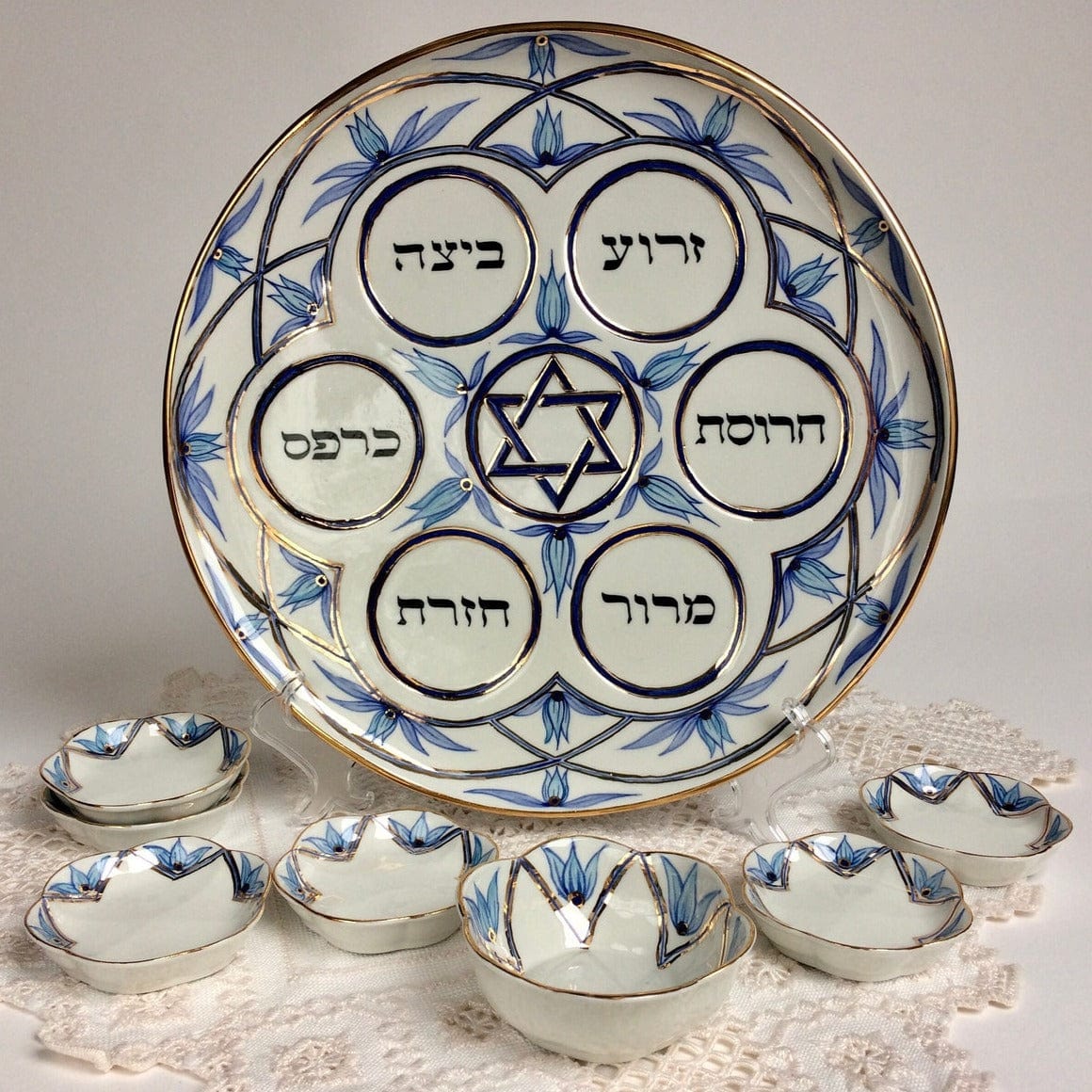





Navy, Turquoise and Gold Floral Porcelain Seder Plate and Salt Bowl

Sign in with your email to save this. No password, just a code we send you, and we'll bring you right back with it saved.
Free Shipping
On orders over $99
30 Day Returns
Guilt-free
Top Rated
115K+ kvelling customers
Description
Stunning hand-painted Seder Plate set includes 8 pieces: Seder plate, 6 small bowls for the traditional foods, and a slightly bigger bowl for salt water.
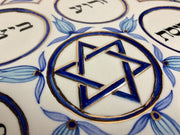
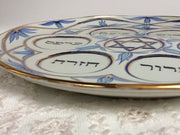
The blue and the navy colors are hand-painted in an Art Nouveau style, with touches of gold. The names of the traditional foods are written in Hebrew with a Star of David in the center. A true modern heirloom. Coordinating matzah plate sold separately.
Size: Seder plate 32 cm/13 inches in diameter, the small bowls are 7.5 cm/ 3 inches in diameter.
Handmade in Hungary.
About the brand

Judaica Hungarica is the Budapest porcelain studio of Zsuzsa Ujj, whose menorahs, seder plates and honey jars draw on Hungarian ceramic tradition.
We're featured in


About the brand
Judaica Hungarica
Judaica Hungarica is the Budapest porcelain studio of Zsuzsa Ujj, whose menorahs, seder plates and honey jars draw on Hungarian ceramic tradition.
- Based in
- Budapest, Hungary
- Craft
- Hand-cast porcelain
Zsuzsa Ujj makes porcelain Judaica in her Budapest ceramic studio under the name Judaica Hungarica. She found clay early: at four she was playing with clay from the bottom of a puddle near Lake Balaton. By 14 she was at a specialized high school for ceramic arts, and she went on to the Hungarian Academy of Crafts and Design. She later taught geometry at an arts school, and that feel for curves and proportion runs through her work.
Each piece starts with hand carving and poured casts, then goes into a kiln that fires above 2,600°F. Some are hand-painted with cobalt florals and gold; others stay white and geometric. The pomegranate returns again and again, a Jewish symbol whose seeds are traditionally tied to the 613 mitzvot. Her designs draw on Eastern European Judaica and European Art Nouveau ceramics, in a country home to the Herend and Zsolnay workshops, and one mezuzah case borrows its motifs from Budapest's Rumbach Synagogue.
Ujj has said that people buying ceramic Judaica, fragile and hard to carry, is a sign they feel safe.